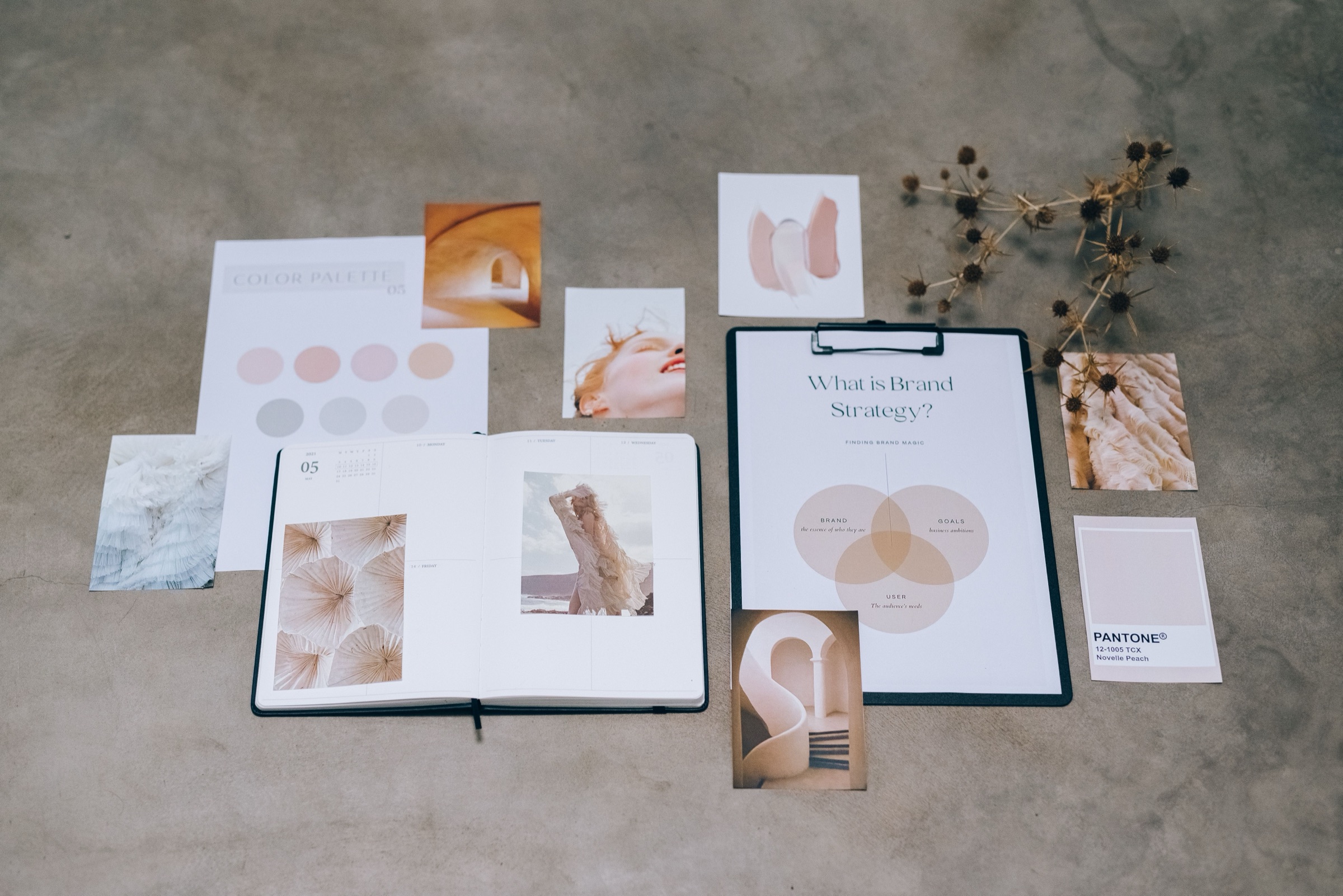
Almost every business has a logo. Very few have a brand identity. The difference isn't budget — it's process: brand identity is built in a specific order, and skipping steps is the number one reason so many new brands feel generic.
When a business in Puerto Vallarta, the Riviera Nayarit or Bahía de Banderas comes to us to "get a logo made," what it usually needs is something deeper: a complete system that lets it communicate the same way on its storefront, its website, its social media, and in how its team answers the phone. This guide is the actual process we follow to build it, step by step.
What brand identity is (and isn't)
Brand identity is the set of verbal and visual elements — name, purpose, personality, visual system and tone of voice — that make a business recognizable and consistent at every touchpoint. It isn't the logo. The logo is just one of the symbols that represents that identity, probably the most visible one but not the most important.
A well-built brand identity consistently answers three questions: who we are, who we're talking to, and why they should choose us over the competition. If your business can't answer those three questions clearly in a single sentence, that's where the work starts — before opening any design program.
Step 1: research before design
The mistake we see most often is starting with color and typography. Visual identity is the last decision in the process, not the first. Before designing anything, three things need to be understood:
Your real audience. Not "anyone who wants to buy," but the specific customer profile that most values what you offer — their age, expectations, where they look for information, and what concerns them before deciding.
Your direct competition. Not to copy it, but to avoid looking like it. If every boutique hotel in your area uses the same shade of blue and the same serif typeface, that's exactly the combination you should avoid.
Your real differentiator. The concrete, verifiable reason a customer would choose you. Not a generic adjective like "quality" or "excellence" — something specific only you can honestly claim.
Step 2: defining the brand's territory
With research done, the next step is strategy: the (brief, not a treatise) document that defines the brand's purpose, its positioning against the competition, its personality and its core promise. This document guides every design decision that follows — and it's also what keeps the project from becoming a debate over personal taste.
Brand personality deserves special mention. Like a person, a brand can be warm or formal, bold or discreet, playful or serious. Choosing that personality with intention — not by default — is what later makes copy tone, photo selection, and even the type of music in a promotional video feel consistent with one another.
Step 3: naming, when it applies
If the business already has a name, this step is skipped. If it's yet to be defined, naming must meet four criteria: be easy to pronounce and remember, be available as a .com domain or a reasonable variant, not conflict with existing trademarks, and — the criterion most often ignored — say something about the positioning, not just sound good.
A good name doesn't have to explain everything you do. It has to leave room for the brand to fill it with meaning over time.
Step 4: the visual system (now, the logo)
With strategy and naming settled, design comes in. A complete, professional visual system includes, at minimum:
Logo in real variants. Primary version, reduced version for small spaces, single-color version, negative version for dark backgrounds. A logo that only works in one version isn't a system — it's an image.
Color palette with exact codes. Primary and secondary colors defined in HEX, RGB and CMYK, so any vendor — print shop, signage, uniforms — uses exactly the same blue, not an approximation.
Typography with defined hierarchy. Which typeface is used in headlines, which in body copy, and the sizing and spacing rules that keep consistency between the website and printed materials.
Photographic and graphic style. A clear criterion for what kind of photography represents the brand — light, composition, presence or absence of people — so every image published feels part of the same system, no matter who shot it.
The brand guidelines test
If you handed your identity system to a new vendor who has never seen your business before, could they produce a correct piece of work without asking you anything? If the answer is yes, you have real brand guidelines. If the answer is "it depends who interprets it," you still need more documentation.
Step 5: brand voice
The visual system is half the work. The other half is how the brand sounds when it writes: on the website, on social media, in a customer follow-up email. Defining brand voice means deciding vocabulary, formality level, how it addresses its audience, and which topics are — and aren't — within its territory of conversation.
A brand with a defined voice is recognizable even without seeing the logo. That's the real proof the identity is working beyond the visual.
The most common mistakes when building brand identity
After more than twelve years doing this work for hotels, real estate developments and lifestyle brands in Puerto Vallarta and the Riviera Nayarit, here are the mistakes we see most often: designing before researching, choosing colors and typography based on the owner's personal preference instead of strategy, not documenting the system in a usable guide, and — perhaps the costliest — changing identity elements every few months, which prevents the brand from building recognition in customers' minds over time.
Consistency, not perfection, is what builds brand recognition over time. A simple identity applied with discipline beats a sophisticated identity applied inconsistently.
When it's the right time to invest in this
You don't need to be a hotel chain to need real brand identity. You need it if your business already has traction but looks different on every platform, if you're about to launch something new and want to start on the right foundations, or if you feel your current communication doesn't reflect the quality of what you actually offer.
At Estudio Alterna we run this complete process — research, strategy, naming when it applies, visual system and brand voice — for tourism, real estate and lifestyle businesses in Puerto Vallarta, the Riviera Nayarit and Bahía de Banderas. If you're about to build or reorganize your brand identity, we'd be glad to take a look at where you stand today.